
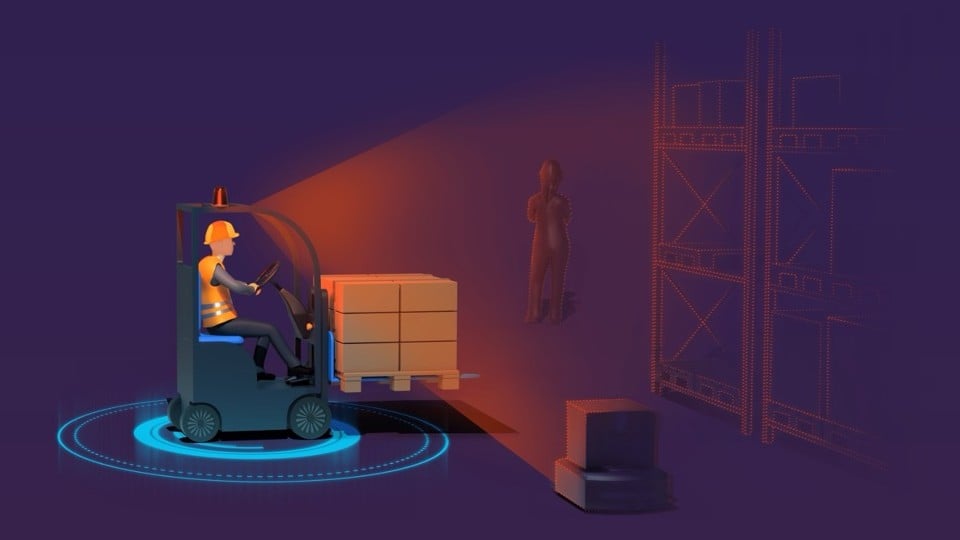
Forklifts remain the backbone of modern distribution centers and logistics facilities. Millions of vehicles are operated manually every day, moving materials between production, storage, and shipping areas. Yet despite their central role, most facilities operate with limited visibility into how forklifts actually move.
Routes, congestion, dwell times, and utilization patterns often remain invisible. Process improvements are frequently based on assumptions rather than reliable movement data, leaving hidden inefficiencies unresolved.
The Visibility Gap in Industrial Operations
Many locating technologies are available to track mobile assets in industrial environments. However, traditional real-time locating systems (RTLS) typically require dedicated infrastructure such as anchors, tags, or extensive installation effort. This can make deployments complex, costly to scale, and difficult to retrofit in existing facilities.
As a result, a large portion of forklift fleets continues to operate without detailed movement transparency, limiting opportunities to optimize material flow, improve safety, and increase operational efficiency.
Infrastructure-Free Localization with Visual SLAM
A new approach to industrial localization uses camera-based positioning and spatial mapping. Instead of relying on fixed anchors or extensive infrastructure, visual SLAM systems determine position by continuously analyzing environmental features within the facility.
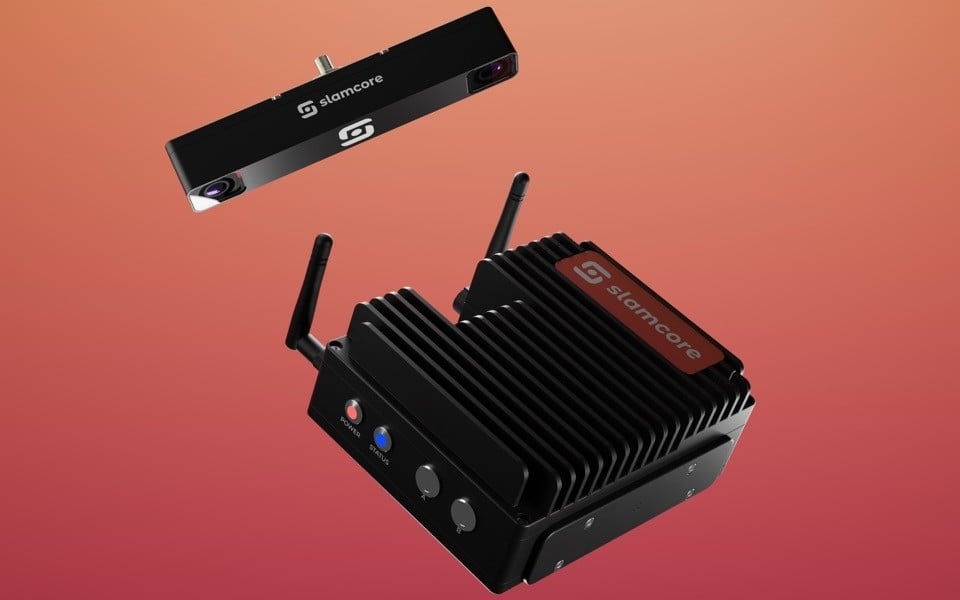 Infrastructure-free RTLS solutions based on visual SLAM are now available from specialized providers such as Slamcore, offering high-accuracy, industrial-grade localization that can be mounted directly on forklifts. This enables:
 Precise positioning without dedicated infrastructure
- Rapid deployment and straightforward retrofitting of existing fleets
- Reliable operation in dynamic industrial environments
- Continuous capture of motion behavior and spatial context
By equipping forklifts with on-vehicle spatial awareness, facilities gain a scalable and flexible way to generate precise movement data across their operations.
From Position Data to Operational Insight
While accurate localization provides the data foundation, operational value emerges when this data is transformed into actionable insights.
Flowcate’s DeepHub converts raw forklift position streams into operational intelligence by providing spatial context, geofence-based events, and real-time analytics. Facilities gain visibility into how forklifts move, interact, and perform across the entire site.
Typical insights include:
- Movement patterns and traffic flows
- Bottlenecks and congestion zones
- Fleet utilization and activity levels
- Route behavior and process inefficiencies
- Dwell times and operational delays
This enables data-driven optimization of material flow, layout design, and overall operational performance.
Unified Spatial Intelligence with omlox
Industrial environments typically operate heterogeneous fleets consisting of manual forklifts, automated guided vehicles (AGVs), autonomous mobile robots (AMRs), and tracked goods or assets. Integrating location data from multiple technologies is therefore essential to achieve a unified spatial view across operations.
Flowcate’s DeepHub is the premier omlox-certified middleware platform that unifies location data from different sources into one shared spatial view. The platform is built on the open locating standard omlox – whose hub architecture was originally defined by Flowcate and later standardized within PI – enabling interoperability across positioning technologies and vendors.
This allows organizations to:
- Combine vision-based localization with traditional RTLS technologies
- Integrate data from automated vehicles, people, and goods
- Connect location data to industrial automation and enterprise systems
- Enable scalable and future-proof locating architectures
By harmonizing heterogeneous location sources, facilities gain holistic visibility of everything that moves within the industrial environment.
Complementing Existing RTLS Deployments
Infrastructure-free vision-based localization does not replace traditional RTLS solutions. Instead, it complements existing technologies by providing an efficient way to retrofit manual forklift fleets and extend spatial visibility where fixed infrastructure may not be practical.
This makes infrastructure-free localization particularly effective for retrofitting existing forklift fleets and generating movement transparency where fixed RTLS infrastructure is not feasible.
Across industrial sites, however, multiple tracking technologies typically coexist. The ability to combine these solutions and integrate their data seamlessly therefore becomes critical. Interoperable location data architectures based on standards such as omlox enable this integration, allowing different positioning technologies to contribute to a shared spatial view of operations.