
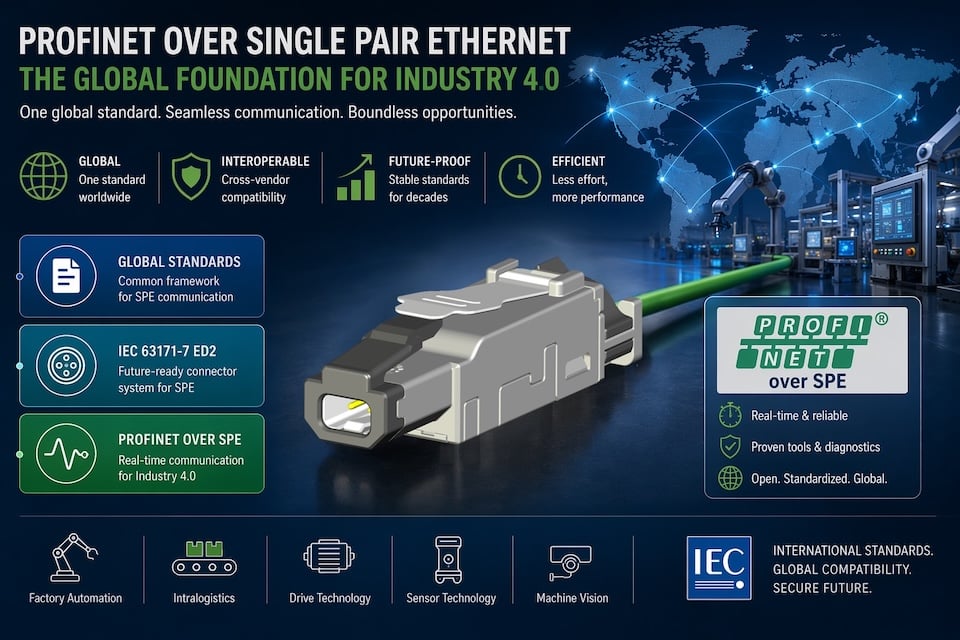
A Milestone in Industrial Networking
Industrial automation is at a turning point. While traditional fieldbuses such as PROFIBUS and DeviceNet are increasingly being replaced by modern Ethernet-based solutions, Single Pair Ethernet (SPE) is emerging as a revolutionary concept that enables Ethernet communication over a single pair of wires. But SPE is far more than just a technical innovation; it is the foundation of a globally synchronized standardization movement that enables machine builders and automation engineers worldwide to develop future-proof and internationally interoperable systems.
The key to this success lies in a precisely coordinated set of standards developed by the International Electrotechnical Commission (IEC) and numerous industry consortia. This harmonized set of standards forms the foundation for a truly global solution—one without multiple certifications, proprietary silos, or the fragmentation that has historically hindered the seamless implementation of Industry 4.0.
Standards Families as an Architecture of Compatibility
The significance of SPE standardization cannot be gauged by a single standard. Instead, an entire ecosystem of coordinated standards has emerged, which must fit together like pieces of a puzzle. The following overview presents the key standards and their respective roles within the overall framework.
IEC TS 63444: The Data Frame Foundation
This project is to transform the existing IEC TS 63444 to an IS as announced in the IEC SC65C plenary in 2024. The work will be synchronized with the IEC 61158 Edition 2028 work in 65C/WG 9. Some elements of the IEC TS 63444 could go into IEC 61918:2028. It defines the basic requirements for system designs and data transmission via SPE. It establishes the conceptual foundation that enables different protocols, including PROFINET, as well as other standards, to communicate via a common SPE physical layer. Without this standard, a scenario would arise in which SPE hardware exists, but each manufacturer sets its own rules, with the well-known consequences for interoperability and investment security.
IEC 63171-7 ED2 – The Connector Standard of the Future
The second edition of IEC 63171-7 specifies M12 hybrid connectors for SPE with power transmission capabilities for industrial applications, as well as a connector system without additional power contacts in the familiar M8 and M12 metric systems, and also an IP20 rating for equipment use in protected environments. This creates an ecosystem for higher power densities, improved shielding concepts, and more precise tolerance specifications, ensuring reliable plug-and-play compatibility between products from different manufacturers.
IEC 61158-2-100: The Physical Layer of PROFINET over SPE
As industrial applications become increasingly digitized, there is a growing need for uniform and high-performance communication solutions that span from the cloud to the field level. The IEC 61158-2-100 standard addresses these requirements by specifying a standardized physical transmission layer based on Single Pair Ethernet (SPE) and Ethernet-APL. It thus lays the foundation for end-to-end, scalable, and interoperable networks in process, factory, and building automation, while also enabling the use of modern Ethernet technologies even under demanding industrial and potentially explosive conditions.
In particular, it describes the technical framework for 10BASE-T1L and 100BASE-T1L, including data transmission (10/100 Mbit/s), power delivery over the same two-wire line, and ranges of up to approximately 1 km. A key element is the definition of port, segment, and performance classes, as well as intrinsically-safe profiles, to ensure standardized and secure interoperability —even in potentially explosive atmospheres. In addition, the standard specifies topologies (trunk/branch), cabling rules, connector requirements, and EMC aspects to enable robust industrial networks.
It thus provides a harmonized, technology-neutral specification for Single Pair Ethernet, which serves as the basis for future IEC standards and industrial Ethernet applications. It serves as the basis for the IEC 61784-1, -2, and -5 series of standards, which define the communication profiles for industrial networks (fieldbus and Industrial Ethernet) as well as the associated installation profiles for the standardized implementation and interoperability of these systems.
PROFINET over SPE: The Middleware Between the Standard and the Application
While the standards define the infrastructure, PROFINET over SPE bridges the gap to industrial applications. For more than two decades, PROFINET has been an established standard for real-time communication in factory automation—a protocol that combines determinism, reliability, and comprehensive diagnostic capabilities.
By porting PROFINET to SPE technology, based on IEC 61158-2-100 and related standards, a unique scenario emerges: Machine builders can run their proven PROFINET applications on SPE hardware without having to make fundamental changes to the application layer. The same engineering environment, the same diagnostic tools, and the same safety concept remain usable.
This is no small matter. Historically, new fieldbuses or communication protocols have regularly led to a complete redesign of machine concepts. PROFINET over SPE breaks this pattern, enabling evolution rather than revolution.
The International Significance: A Global Industry 4.0 Network
The true strength of this standards framework lies in its global reach. The IEC is an international body; its standards apply not only in Europe but worldwide. A machine manufacturer in Germany can use the exact same SPE ecosystem as a manufacturer in Japan, the United States, or Singapore. This has several strategic implications for global industry.
Long-Term investment reliability
Standards are only valuable if they remain stable and supported over the long term. Once adopted, IEC standards typically remain valid for many years, and new editions are designed to maintain backward compatibility. The second edition of IEC 63171-7 represents a step forward yet remains conceptually compatible with the first edition. This provides investors with planning certainty.
Outlook: PROFINET over SPE as the Industry’s “lingua franca”
The standardization of Single Pair Ethernet is not yet complete. Standards bodies and consortia are already working on enhancements: higher data rates, different transmission distances, expanded security profiles, and integration with Time-Sensitive Networking (TSN) to meet even more deterministic real-time requirements. These developments will further strengthen the SPE ecosystem and expand its range of applications.
But the foundation is in place: a global set of standards approved by international bodies that allows machine builders to implement Industry 4.0 not as a patchwork of proprietary standards, but as a coherent, globally functioning ecosystem. PROFINET over SPE reinforces this trend by, for the first time, seamlessly migrating an established real-time protocol to a new physical layer—without interruptions, without proprietary variants, and without regional fragmentation.
This is not merely a technical achievement; it is a regulatory success that will have a lasting impact on the next decade of factory automation. The message is clear: standardization is not bureaucracy, but rather the key to global innovation and economic success.