
The strategic focus of digital transformation lies in predictive maintenance, adaptive manufacturing, and integrated quality control. Productivity gains and cost savings result from the use of advanced digital solutions such as AI-based analytics and digital twins.
All these technologies have one thing in common: they run at the IT level and require access to vast amounts of data from the production process, generated by field devices at the OT level. This vertical communication is therefore an essential prerequisite for the future smart factory.
However, the established automation pyramid, with its rigid hierarchical separation of IT and OT and its distinct communication networks, has so far hindered this development. After all, flexible data exchange requires open and continuous data highways —converged networks.
PROFINET already meets many of these requirements today and is therefore, not without reason, the number one choice in the OT world.
Security and Semantics Take Center Stage
For vertical communication, however, two other topics are of crucial importance in addition to connectivity: cybersecurity and semantics. In the traditional factory, the IT/OT boundary acts like an implicit cell protection, and the issue of access control is thus handled by gateways and firewalls with correspondingly complex configuration. With a converged network, these barriers are eliminated. Access control must be handled directly at the communication endpoint: the field device. The PROFINET security features of authentication and access control are available for this purpose. This creates the prerequisite for consistent and centralized user management.
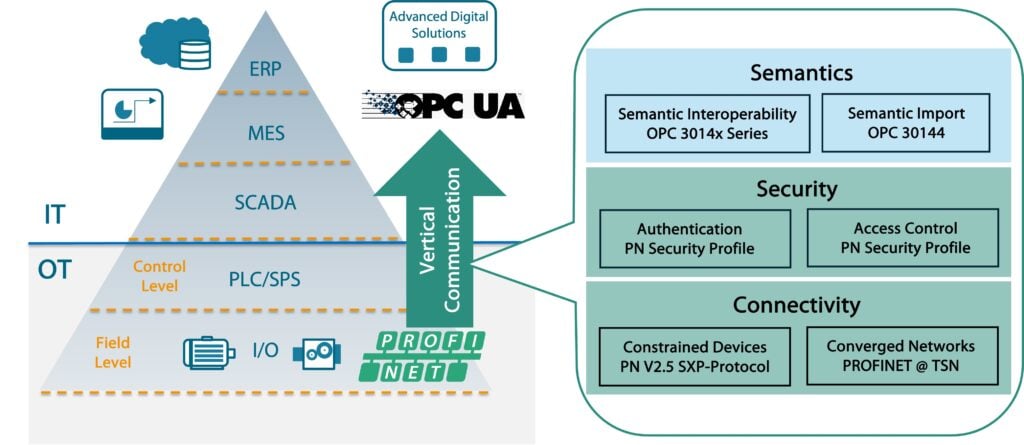
Also effortless data semantics are a must-have for vertical communication. In contrast, when accessing data via a classic serial fieldbus, the user receives only the data value. The semantics are buried in a user manual. IT applications, however, expect data objects consisting of data and metadata. Today, OPC UA is the dominant middleware in the IT sector when it comes to information models and information exchange. So, when data is transmitted upward via the fieldbus, it must first be semantically enriched in an edge device and converted to OPC UA. Here, a distinction must be made between internal and external semantics:
- Internal semantics encompasses all metadata resulting from an internal device model; for a measured value, this includes, for example, the data type, the physical unit, or the value range.
- External semantics encompasses application-specific information derived from application engineering, e.g., that the measured value pertains to the flow of the heating system for boiler 3.
In today’s edge applications, this semantic enrichment of data is largely performed manually. This involves significant effort and is correspondingly inflexible.
Semantic Interoperability
Internal semantics are device-specific and can therefore be imported automatically from the device description file (PROFINET GSD). With OPC UA Part 30144, extended keywords are available in the GSD to describe the data available on the device, along with their semantic mapping to an information model. This enables a generic information model and automated processing at the edge.
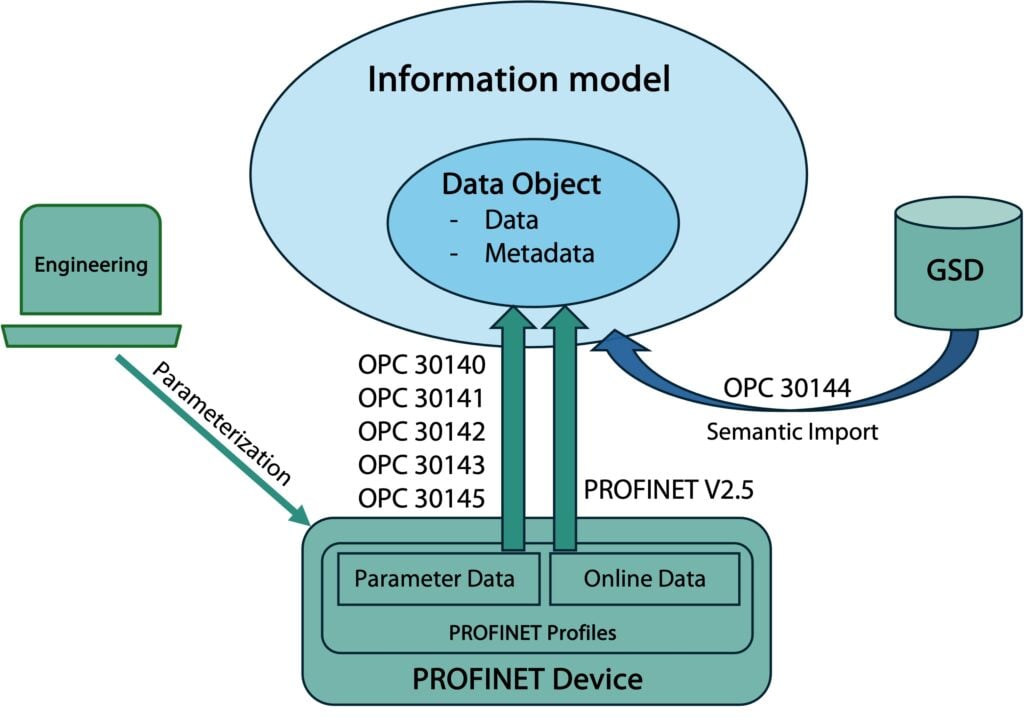
The plant’s engineering tool is the primary source for the external semantics. An automated import for vertical communication is possible via the device’s corresponding parameterization data. These standardize the PROFINET Profile(s) with the associated OPC Companion Specification(s).
Meanwhile, larger devices such as robots and drives are also coming onto the market, which in addition to PROFINET, also feature an integrated OPC UA server for vertical communication. Here too, device manufacturers and app developers benefit from the standardized information models derived from the PROFINET Companion Specifications. These ensure semantic interoperability and thereby reduce costs for devices and applications.
The Path via Edge Devices
But what happens in brownfield installations with older devices or with new field devices featuring Single-Pair Ethernet (SPE) and power supply via the two-wire line (P0DL)? For such constrained devices, vertical communication via edge devices is the only option.
With the introduction of SXP in PROFINET V2.5, the requirements of vertical communication are also addressed. It provides new, powerful communication channels and enables efficient data- and event-driven communication.
The solution toolkit now includes the edge, OPC UA servers on devices, and standardized information models. The edge is a key component for integrating constrained devices, such as those now entering the market in the form of SPE devices. This also enables the gradual migration from brownfield installations to smarter factories.
With these new components in the PROFINET ecosystem, data can be made available more flexibly and cost-effectively, paving the way for smart digital solutions. This applies regardless of whether you are planning a smart factory or wish to further develop your existing production through the use of advanced digital solutions. With PROFINET and its associated ecosystem, a scalable solution is available that covers all aspects of vertical communication. It is also important for device manufacturers that, with PROFINET, are relying on a solution that is both compatible and future-proof.
 Dr. Andreas Uhl