
Building High Availability into Critical Infrastructure Networks
Executive Summary
The modern data center is undergoing a fundamental transformation. Driven by artificial intelligence, machine learning, and high-performance computing workloads, new facilities are growing in both scale and complexity. Hyperscale campuses now consume power at levels previously associated with industrial manufacturing sites, while advanced liquid cooling systems, water treatment facilities, battery energy storage systems, and utility-scale electrical distribution networks are becoming standard components of the data center environment. As a result, the operational technologies responsible for managing these physical systems have become as critical to uptime as the servers they support.
Historically, data center resiliency efforts focused primarily on equipment redundancy. Designers specified redundant utility feeds, backup generators, uninterruptible power supplies, chillers, cooling towers, pumps, and network connections. While these strategies remain essential, they address only part of the availability challenge. The infrastructure that coordinates and controls these assets increasingly relies on networked automation systems. If communications or controllers fail, the presence of redundant mechanical or electrical equipment alone may not guarantee uninterrupted operation.
 This reality is driving a growing interest in industrial high-availability networking technologies. PROFINET provides an architecture designed to eliminate single points of failure within automation systems by maintaining redundant communication paths, redundant controller relationships, and synchronized control systems. Features such as Media Redundancy and S2 Redundancy represent key components of this broader System Redundancy strategy, enabling continuous operation even when network infrastructure or automation controllers become unavailable.
As hyperscale and AI-focused facilities continue to evolve into utility-scale infrastructure environments, PROFINET System Redundancy offers a proven framework for achieving the availability objectives demanded by modern data center operators.
From IT Facility to Industrial Infrastructure
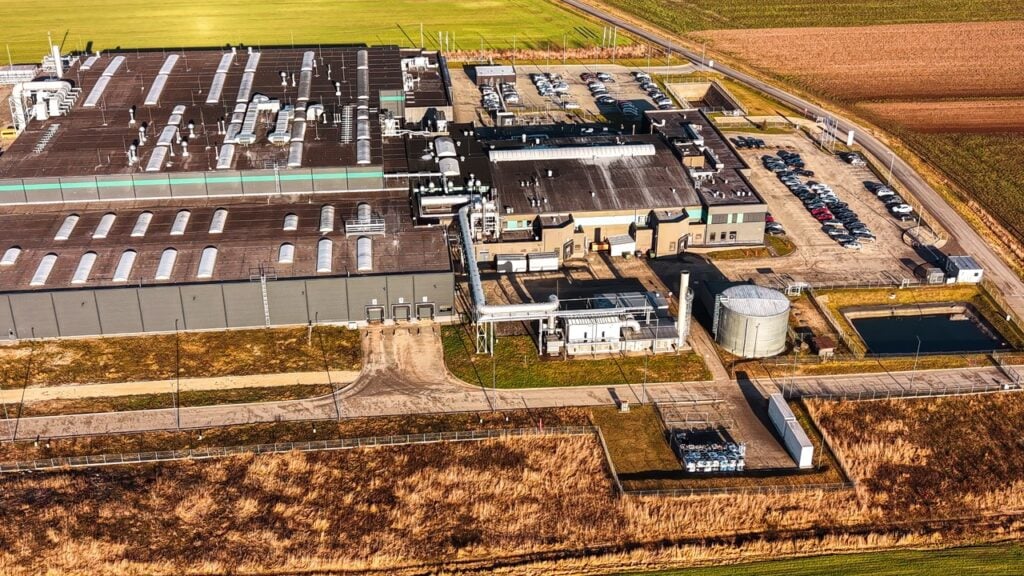
For decades, data centers were primarily viewed through an information technology lens. The servers inside the building represented the primary source of value, while power distribution systems, cooling equipment, and facility controls were considered supporting infrastructure. Today, that distinction is becoming increasingly blurred.
Modern AI clusters can require several times the power density of traditional compute environments. In response, operators are deploying increasingly sophisticated cooling architectures that include direct-to-chip cooling, cooling distribution units, large-scale pumping systems, heat exchangers, advanced water treatment processes, and highly automated energy management platforms. Simultaneously, electrical systems are expanding to include medium-voltage distribution, microgrids, battery energy storage systems, generator plants, and advanced power quality monitoring. As these facilities continue to scale, they increasingly resemble industrial process plants rather than conventional office buildings. The infrastructure layer itself has become a mission-critical environment requiring continuous visibility, coordination, and control.
Within this environment, automation systems serve as the operational nervous system of the facility. Thousands of sensors, drives, controllers, relays, meters, and field devices exchange information continuously to regulate cooling capacity, manage water flow, coordinate backup generation, balance electrical loads, and provide data to supervisory systems such as Building Management Systems (BMS), Electrical Power Monitoring Systems (EPMS), and Data Center Infrastructure Management (DCIM) platforms. The availability of these automation networks is therefore becoming inseparable from the availability of the data center itself.
High Availability as a System Requirement
Traditional redundancy strategies assume that equipment failures represent the primary threat to uptime. As a result, operators often deploy N+1, 2N, or even greater levels of redundancy throughout their facilities. While these approaches successfully address failures of individual assets, they do not necessarily eliminate vulnerabilities within the control infrastructure responsible for coordinating those assets.
Consider a cooling system consisting of multiple redundant chillers and pumping systems. Although mechanical redundancy may be fully implemented, a communication failure that prevents controllers from coordinating those assets can create operational challenges. Similarly, a backup generator plant may contain sufficient capacity to support a utility outage, but controller failures during a transfer event can still affect system performance.
Consequently, availability must be viewed as a system-wide characteristic rather than a property of individual equipment. The communications network, controllers, and field devices must all contribute to a resilient operational architecture. It is in this context that PROFINET System Redundancy becomes particularly relevant.
Understanding PROFINET System Redundancy
PROFINET System Redundancy is designed to maintain continuous operation despite failures within the automation environment. Rather than focusing on a single component, it provides a comprehensive high-availability framework that addresses multiple potential failure modes. Within this framework, Media Redundancy and S2 Redundancy serve as foundational capabilities that work together to support overall system availability.
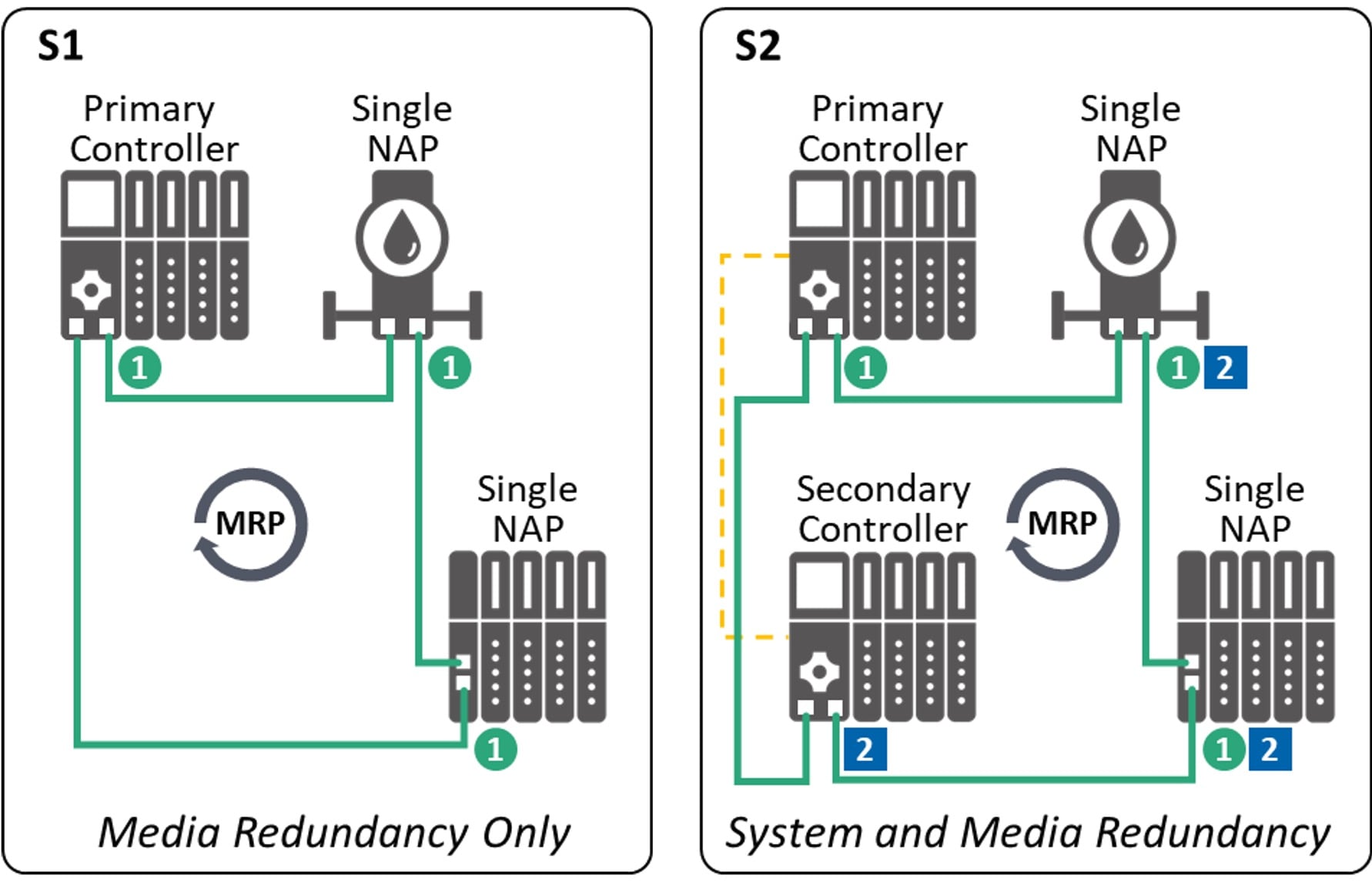
Media Redundancy addresses failures within the communication infrastructure itself. S2 Redundancy addresses failures at the controller level by enabling field devices to communicate with multiple controllers. Together, these capabilities support the broader objective of System Redundancy: maintaining uninterrupted control of critical processes despite failures in networks, devices, or controllers. Media Redundancy and S2 Redundancy should be viewed as complementary elements of a holistic high-availability architecture.
Media Redundancy and Network Availability
Media Redundancy provides protection against failures within the physical communication network via the Media Redundancy Protocol (MRP). In a conventional architecture, a damaged cable, failed network switch, or accidental disconnection can interrupt communications between controllers and field devices. Such failures may result in loss of visibility, degraded automation performance, or process interruptions.
Within a high-availability PROFINET architecture, redundant communication paths allow data to continue flowing even when portions of the network become unavailable. Communication can automatically transition to an alternate path without requiring manual intervention. For data centers, this capability is particularly valuable because infrastructure assets are frequently distributed across large campuses.
S2 Redundancy and Controller Availability
While MRP addresses failures within the network infrastructure, S2 Redundancy addresses failures at the automation controller level. In an S2 architecture, a PROFINET field device establishes communication relationships with both a primary controller and a backup controller. Although only one controller actively directs the process, the field device remains known to both systems. By ensuring that devices remain accessible to redundant controllers, S2 Redundancy extends availability beyond the network layer and into the control layer itself.
System Redundancy Across Data Center Infrastructure
The true value of System Redundancy emerges when these capabilities are applied to mission-critical infrastructure applications.
Within central cooling plants, controllers coordinate the operation of chillers, cooling towers, heat exchangers, pumps, and associated instrumentation. MRP protects communications between distributed equipment, while S2 Redundancy ensures that field devices remain available to redundant controllers. Together, these capabilities support uninterrupted cooling operations even during communication or controller failures.
The same principles apply to liquid cooling systems. AI data centers increasingly depend on cooling distribution units, secondary coolant loops, temperature monitoring systems, and intelligent pumping architectures. System Redundancy provides a fault-tolerant foundation capable of supporting these next-generation cooling architectures.
Electrical power systems represent another critical application area. Generator plants, medium-voltage switchgear, synchronization controls, protection systems, and battery energy storage assets all depend on reliable communications and coordinated automation. Through the combined capabilities of MRP and S2 Redundancy, System Redundancy helps ensure that controller or network failures do not compromise operational continuity during critical events.
Water management systems likewise benefit from a high-availability architecture. Water treatment facilities, filtration systems, chemical treatment processes, pumping stations, and storage systems increasingly support both operational and sustainability objectives within hyperscale campuses. System Redundancy helps ensure that critical water infrastructure remains operational even when failures occur within individual system components.
Enabling BMS, EPMS, and DCIM Architectures
Data center operations increasingly rely on enterprise-level management platforms that aggregate data from thousands of devices throughout the facility. In this architecture, PROFINET serves as the operational foundation connecting sensors, instruments, drives, controllers, and field devices. Media Redundancy helps ensure continuous data availability from distributed assets. S2 Redundancy improves controller resilience. Together, these capabilities support System Redundancy, which in turn enhances the reliability of the information flowing to supervisory platforms.
Conclusion
The next generation of data centers is defined not only by computing performance but also by the sophistication of the infrastructure that supports it. PROFINET System Redundancy addresses this challenge through a layered high-availability architecture. Media Redundancy protects communication paths. S2 Redundancy protects controller relationships. Together, they contribute to a comprehensive System Redundancy strategy that maintains continuous operation despite failures within the network or automation environment.