
Anyone who has been following the development of MTP over recent years will notice a significant shift in 2026. For a long time, the focus was on questions such as: How does MTP work? Which functions need to be standardized? And does the concept prove its worth in practice? The discussion has now shifted. Today, the focus is increasingly on how MTP can be rolled out across the industry, how companies can get started, and how to ensure that solutions from different manufacturers work together reliably.
State of the Standard
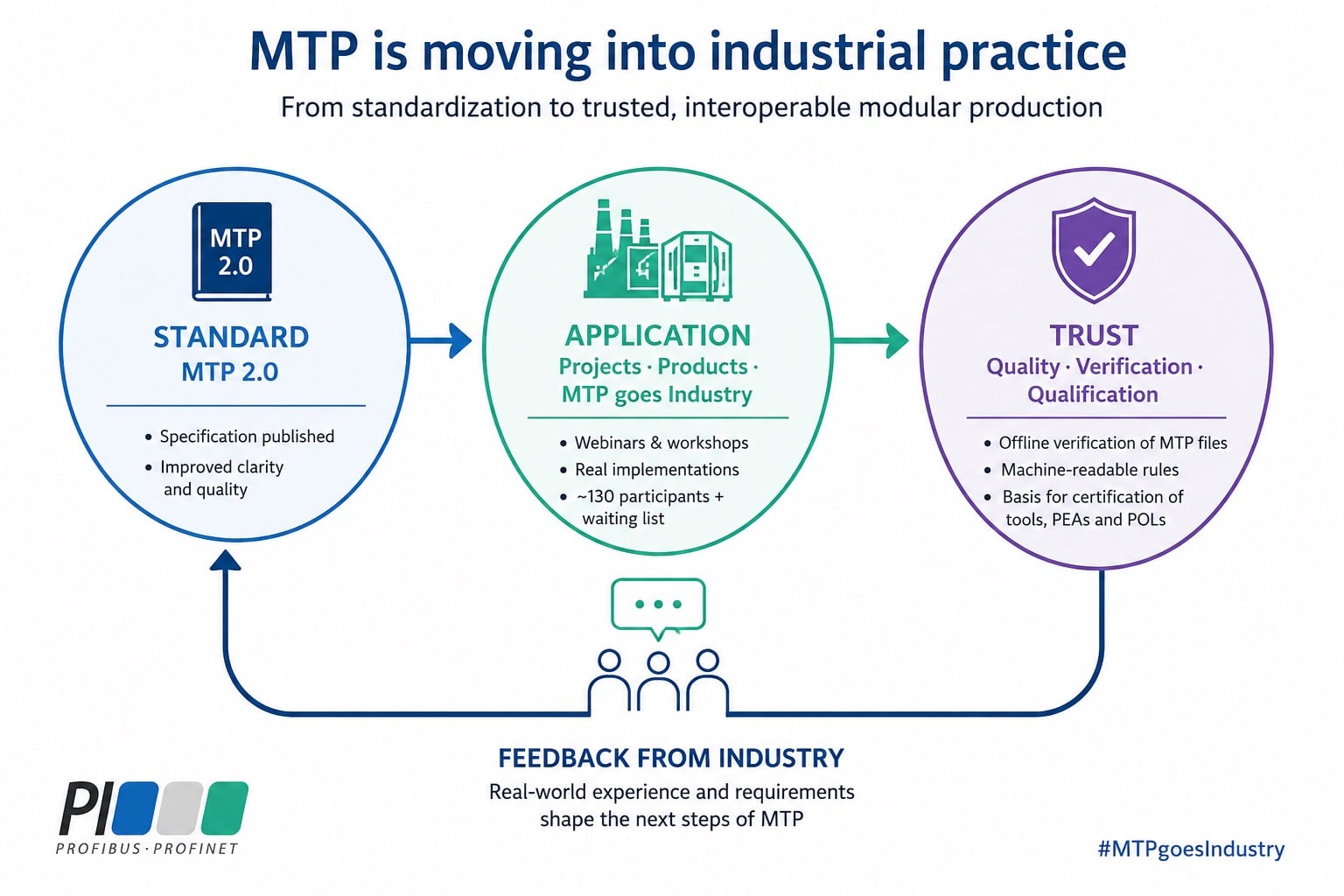
 An important milestone in this regard was the release of MTP 2.0 in January 2026. With this new version, the standard has taken a significant step forward. The specifications provide greater clarity, improve the foundation for high-quality Module Type Packages and help prepare MTP for wider industrial application.
At the same time, the ecosystem is growing. More and more manufacturers are integrating MTP into their products, the first projects are being implemented in production, and new tools are supporting engineering, validation and qualification. This is also changing the nature of the work within PI. In addition to further developing the specification, market launch, the exchange of experience and quality assurance are taking center stage.
A key focus this year is therefore on formats that bring MTP closer to practical application. Webinars, workshops and other information resources address a wide range of issues: from PEA design and sensible modularization, through integration into a process orchestration layer, to specific engineering and integration processes. In June, for example, in collaboration with PAVIS and Merck, the focus was on how Plug & Produce can be implemented with MTP 2.0 in real-world projects.
MTP Goes Industry & Beyond

The level of interest that has now been generated is particularly evident in our new event “MTP goes Industry”, which will take place on September 29 at Merck in Darmstadt. Originally, a relatively small group comprising PEA manufacturers, operators, system integrators and technology providers was planned. The response has far exceeded our expectations. The approximately 70 places originally allocated were quickly snapped up. Together with Merck, we were able to expand capacity to around 130 participants – and even then, a waiting list was formed.
For me, this is one of the strongest signals of the year. The questions coming from the market are becoming more specific. Manufacturers want to know how they can make their products MTP-compatible. Operators are considering what requirements they should set for PEAs and package units in the future. System integrators want to know what information they need for efficient integration. Added to this are questions regarding engineering effort, qualification, cost-effectiveness, and suitable entry strategies.
These topics also shape the programme at Merck: case studies from industry, a panel discussion with users from various sectors, workshops, laboratory tours and a microfair featuring solution providers. Above all, the format is designed to create space for dialogue between those who develop MTP, integrate it into products, procure it, and subsequently deploy it in plants.
This exchange will continue beyond September. At the Smart Process Manufacturing Congress, PI will present the current status under the title “MTP 2.0 – Quality Aspects, Initial Market Experience, the Latest Developments”.
The exchange will also continue at the NAMUR Annual General Meeting 2026. A joint workshop on “MTP & NOA Update” is currently planned. This offers a good opportunity to bring together the latest developments in both areas and discuss them with end-users.
Up Next: Quality & Conformance
As the use of MTP increases, the importance of another topic is growing in parallel: quality and conformance. A common standard realizes its benefits when its requirements can be implemented and tested in a reproducible manner by different tools and manufacturers. To this end, the PI Joint Working Group on Quality and Conformance Testing, led by Dr. Stephan Hensel, is working on a structured framework for verification, testing and, in the long term, certification.
The first step focuses on the offline verification of MTP files. This examines three levels: the package structure based on the Open Packaging Conventions, the AutomationML/CAEX structure and, finally, the MTP-specific modelling rules. This allows errors to be pinpointed more accurately and detected at an early stage in the engineering process.
Of particular importance here is the translation of normative requirements into machine-readable rules. The rules are separated from the actual testing engine and can be traced directly back to requirements in the specification. In the long term, this approach forms an important foundation for more extensive testing and certification concepts for engineering tools, PEAs and POLs.
For me, these developments illustrate very clearly where MTP stands in 2026. MTP 2.0 provides a significantly more mature technical foundation. The response from the market shows that industrial implementation is gaining momentum. At the same time, the work on quality and conformance is creating a common foundation for reliable interoperability.
This is also changing the role of PI’s work. Standardization, practical experience from the market and quality assurance are becoming increasingly intertwined. I find it particularly exciting to see just how quickly MTP is moving from the working groups into industrial practice. And it is precisely this feedback loop that will be crucial. What works in the real world, what is missing and what companies really need will shape the next steps for MTP.
 Anna Menschner